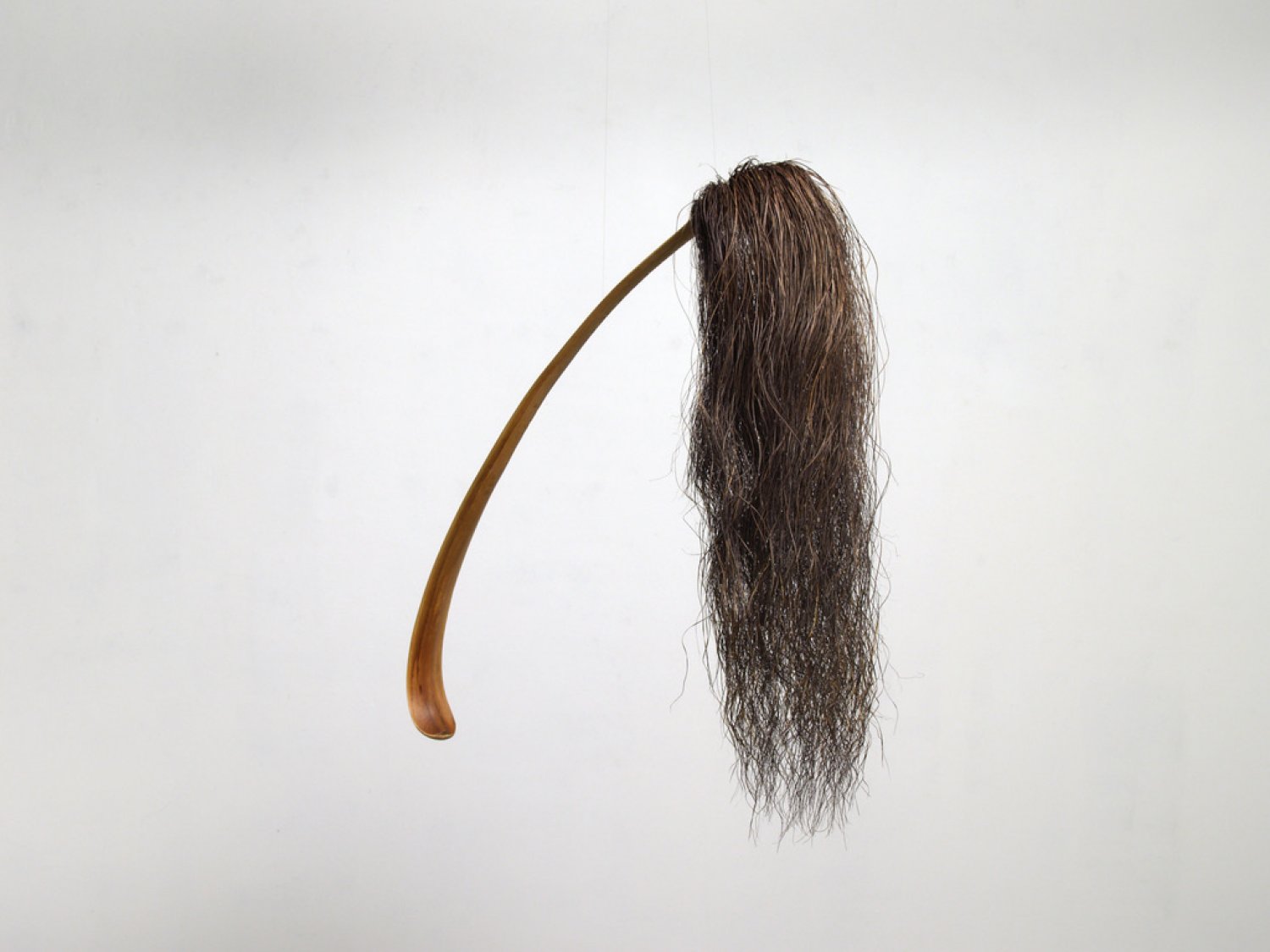
Hossein Valamanesh
Mourning, 2008
fan palm and dye
77.0 x 78.0 x 15.0 cm
2 from an edition of 3 + 1AP; each work is unique
Provenance
Estate of Hossein Valamanesh
Exhibited
Hossein & Angela Valamanesh – This will also pass, Greenaway Art Gallery, Adelaide, 1-26 August 2007, cat. 22
Hossein & Angela Valamanesh, Turner Galleries, Perth, 17 October – 15 November 2008
Hossein Valamanesh, AMA Gallery, Helsinki, Finland, 2009
Hossein Valamanesh: NO LOVE LOST, Grantpirrie, Sydney, 28 May-20 June 2009
Hossein Valamanesh: Puisque tout passe, Institut des Cultures d’Islam, Paris, France, 23 September 2021-13 February 2022
Literature
Ric Spencer, ‘Visual Arts,’ The West Australian, 7 November 2008 (illus.)
Wendy Walker, Hossein Valamanesh: NO LOVE LOST, Grantpirrie, Sydney, 28 May-20 June 2009
Mary Knight and Ian North (eds.), Hossein Valamanesh: Out of nothingness, Wakefield Press, Adelaide, 2011, illus. p. 140
Hossein Valamanesh: Puisque tout passe, Institut des Cultures d’Islam, Paris, France 2021, p. 71 (illus.); p. 123 (illus. and cat. details)
Image courtesy the Estate of Hossein Valamanesh
“I think my art is about not separating elements such as aesthetics, content and form, from each other. The interconnectedness of these elements in the work is important. I hope it is like looking at a tree with all its complexities.” (Hossein Valamanesh, 2014)
Hossein Valamanesh’s five decades of practice in Australia was characterised by an openness to inquiry about the world around us by the unifying of formal, material and conceptual elements. Born in 1949 in Tehran, Valamanesh studied fine arts before emigrating to Australia in 1973. After formative encounters with Aboriginal art, especially at Papunya in 1974, Valamanesh’s practice subsequently comprised five decades of sculpture, painting, performance, installation and video works—both alone and in collaboration with his wife, Angela, or son, Nassiem.
Poetry, especially the canonical works of Persian literature, proved an enduring source of inspiration for individual works across Valamanesh’s career, including The lover circles his own heart (1993; Museum of Contemporary Art, Sydney), which takes its title from the work of the Sufi mystic and poet, Rumi. While not a practitioner of either tradition, Sufism and Buddhism were of great interest to Valamanesh, who seemed drawn to any world view that elevated the natural world to a place of spiritual, transcendent significance.
The artist reflected from time to time on his own migrant experience—as in his sculptural performance Longing, belonging (1997; Art Gallery of New South Wales Collection, Sydney) in which he lit a pyre atop a Persian rug in the middle of the outback to commemorate his twenty-fifth year in Australia. Yet, as the artist once told the critic John McDonald, “It’s a presumption that everything I do must have some relation to my cultural background as though I’m not observing what’s around me. It’s a big mistake.” (John McDonald, ‘Hossein Valamanesh 1949-2021,’ Sydney Morning Herald, 1 February 2022)
Valamanesh collaborated with his wife, Angela Valamanesh, on major permanent installations including An Gorta Mor (The Great Irish Famine Memorial) (1999), Hyde Park Barracks, Sydney and 14 pieces (2005), North Terrace, Adelaide. Their final collaboration was exhibited at the 2022 Adelaide Biennale. Valamenesh also collaborated with his son, filmmaker and multimedia artist Nassiem Valamanesh, on moving image works including Passing Time (2011) and What Goes Around (2021).
Major lifetime surveys of Valamanesh's work were held at the Contemporary Art Centre, Adelaide (1990), the Art Gallery of South Australia, Adelaide (2001), and the Museum of Contemporary Art, Sydney (2002). In 2022, Valamanesh held his first solo exhibition in Europe, Puisque tout passe (This will also pass), at the Institut des Cultures d'Islam, Paris, France.
Works by Valamanesh are in the permanent collections of all major state and national collections in Australia, including the National Gallery of Australia, Canberra, the Art Gallery of New South Wales, Sydney, the National Gallery of Victoria, Melbourne, and the Art Gallery of South Australia, Adelaide, and internationally in the National Gallery of New Zealand, Wellington, and the Aomori Contemporary Art Centre, Aomori, Japan. Many books on Valamanesh’s works were published in his lifetime, including the 2015 monograph Hossein Valamanesh: Out of nothingness edited by Mary Knights and Ian North (Wakefield Press, Adelaide).
Valamanesh died in 2022, aged 72, survived by his wife and son.