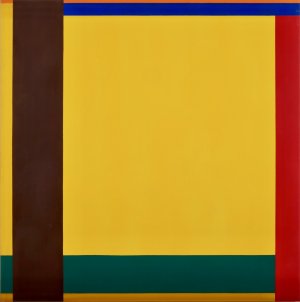
Michael Johnson
Window No 22 also known as No. 8, 1971
acrylic on canvas
183.0 x 183.0 cm
signed, dated and inscribed ‘Michael Johnson 1971 No. 8’ (on the reverse)
Provenance
The artist
Acquired from the above
Literature
Barry Pearce, Michael Johnson, Beagle Press, 2004, illus. p.43 as Window No.22
Michael Johnson lived in New York from 1969-75, where he continued to create the hard-edged, abstract paintings for which he had become known in Australia. Having exhibited in the seminal 1968 exhibition The Field, National Gallery of Victoria, Melbourne, Johnson continued to develop his dual interests in the creative potential of both colour and the grid in his paintings. While his peers began to abandon the colour field in favour of more organic, gestural abstraction, Johnson remained committed to the colour field through much of the 1970s.
Window No 22 recalls the title of his Window one (1969, National Gallery of Victoria, Melbourne), and shows how his practice had developed in a short space of time away from modular canvases back to the flat picture plane. Like other works by Johnson from this period, there are thin bands of colour along the margins that deftly lead you across the surface and provide varied points of reference for each of the painting's fields of colour.
In conversation with the curator and writer Terence Maloon, Johnson described his practice in this period as follows: "Putting down a colour, the first thing you do is oppose it with another colour or give it some kind of sympathy. There's one thing I'm super-aware of right through the 1960s-70s period: at all costs to avoid conventional modelling through chiaroscuro. I wanted to evoke space through the tension between forms, using the energy of colour virtually straight from the manufacturer - without mixing but in the right proportions." ('Michael Johnson - Interview by Terence Maloon' in Tony Bond, Victoria Lynn and Terence Maloon, Michael Johnson Paintings 1968-1988, Art Gallery of New South Wales, Sydney, 1989, p.13.)
Image courtesy of the artist. Photograph by Geoff Boccalatte.
"I wanted to evoke space through the tension between forms, using the energy of colour virtually straight from the manufacturer without mixing, but in the right proportions. Totally lose the surface. It falls away. You start with the experience of the bare gesso, the primed canvas, and that is sublime. That is meditation itself." (Michael Johnson in conversation with Terence Maloon, 'Michael Johnson: Paintings 1968-1988', Art Gallery of NSW, 1989.)
After eschewing figuration and turning to abstraction in the 1960s, Michael Johnson has become one of Australia’s finest abstract painters and masters of colour. After studying in Sydney at the Julian Ashton Art School and East Sydney Technical College through the 1950s, he moved to London in 1960 to study at the Central School of Art. He has exhibited for almost six decades, with early solo exhibitions held in Sydney, Melbourne and New York during the 1960s and 1970s at Central Street Gallery, Gallery A, Max Hutchinson Gallery and direct from the studio. Recalling Kandinsky’s spiritual synaesthesia of colour and music to Rothko’s veils of colour, or from Mondrian’s grids to Frank Stella’s minimalism, each of Johnson’s works is a celebration of the richness of art and art history.
Johnson’s beginnings as an abstract painter came in London in the 1960s, where he became enamoured with the work of Arshile Gorky, Mark Rothko and Kenzo Okada. From London and New York in the 1960s and 1970s to Sydney in the present day, Johnson’s focus has been upon the power of the colour field in works that read as immersive abstract landscapes. Within his expanses of colour, there is also a distinct and continuous attention paid to texture, from sleek, hard-edged, grid paintings in the 1960s and 1970s through to layered, lyrical webs of colour executed from the 1980s to early 2000s. His oeuvre is one of fluid, vital abstraction unfettered from strict geometry or an underpinning ideology, and never at risk of becoming mannered or repetitive: ‘I’m continually trying to avoid blind spots in the repetition of the marks, but they happen, and then there’s a luxury to add more rather than reduce.’
In 1968 Johnson was included in the 'The Field', the inaugural exhibition at the National Gallery of Victoria, Melbourne. In 2018, Johnson’s work returned in ‘The Field Revisited’, National Gallery of Victoria, which commemorated the 50th anniversary of the original show. In 1969 his work was included in the X Bienal Internacional de São Paolo, Brazil, and the UNESCO Biennale, Cagnes-Sur-Mer, France. In 1975 Johnson's first major survey was presented by the Institute of Modern Art, Brisbane, followed by surveys at the University of Melbourne in 1986 and at the Art Gallery of NSW, Sydney in 1989. In 2014 Johnson was awarded the Wynne Prize for Landscape Painting, Art Gallery of NSW, Sydney.