
groundspeed #1, 2001
C type photograph (hand printed analogue print)
60 x 123 cm (image); 80 x 143 cm (paper); 83.5 x 147.5 cm (frame); number 10 from an edition of 15
signed, dated and inscribed with title and edition number ‘Rosemary Laing/ground speed #1/small ED# 10/10/2001’ (on the reverse)
Provenance
The artist
Acquired from the above by the present owner
Exhibited
The unquiet landscapes of Rosemary Laing, Museum of Contemporary Art, Sydney, 25 March- 5 June 2005; Kunsthallen Brandts, Odense, Denmark, 19 May – 3 September 2006 (another from the edition)
Rosemary Laing, TarraWarra Museum of Art, Victoria, 2 December 2017-11 February 2018 (another from the edition)
Literature
V Webb, the unquiet landscapes of Rosemary Laing, Museum of Contemporary Art, Sydney, 2005, exh. cat., illus. p.10 & p.31
A. Solomon-Godeau, Rosemary Laing, Piper Press, Sydney, 2012, illus. p.96-97 V. Lynn & J. Annear, Rosemary Laing, TarraWarra Museum of Art, Victoria, 2017, illus. p.21
Migration and the adaption to a new environment are major concerns throughout the world. In her series groundspeed, Rosemary Laing looked particularly at the Australian situation, symbolically capturing the process of colonisation and the domestication of our native environment, through her images depicting British 1970s carpets laid in lush south coast landscapes.
"Shot on the south coast of New South Wales, groundspeed #1 (2001) shows the vista of a wooded shoreline across glassy water, with only gentle ripples disturbing the reflections of the sky above. The investigations raised in this series correspondingly move from the idealistic imaginings and contemporary modes of transportation of the previous series (flight research) to historic arrivals on the shores of Australia. groundspeed #1 is one work that does not entail an intervention but, through an idyllic vista of land across water, evokes the anticipation of the arrival inherent in a migrant journey." (Vivienne Webb, the unquiet landscapes of Rosemary Laing, MCA, Sydney, 2005, p.10)

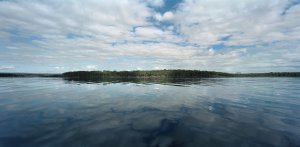
Image courtesy of the Estate of Rosemary Laing